ecobookingGuidesSwitzerland
Unique stays in Switzerland

Guide · Switzerland

Unique stays in Switzerland

Treehouses above the Jura combes, 300-year-old alpine barns at 1,600 m, igloos carved from snow in Zermatt, bubbles opening onto the Matterhorn. Europe’s most expensive country is also the one where you sleep closest to the mountain — and where you get there by train.

ecobooking·2 stays·Updated June 28, 2026
Also available in:FrançaisDeutschEspañolItalianoPortuguês

Switzerland has an advantage almost no other country can claim: you can reach it, and move around it, without a car. Train, postbus, funicular, cable car — the last climb to the alpine chalet is often on foot, pack on your back. That is what makes Swiss unique stays genuinely low-carbon, far more than the European average.

The flip side is the price, and a habit of painting luxury lodges green. At ecobooking we look at what happens behind the photo — energy, water, materials, local roots, rail access — and score every stay from 0 to 100. You contact the owner directly. No booking fee is added to your night.

TreehousesAlpine chaletsIgloosBubblesYurtsWine barrelsDomesTiny houses

Our selection in Switzerland

Sorted by eco-score

What you will — and will not — find in Switzerland

Treehouse

Fewer than in France or Belgium, but spectacular: the terrain does the work. You find them mainly in the Jura, French-speaking Switzerland and the Plateau, rarely above 1,200 m — snow and wind rule out elevated builds at altitude. The best hang from cables without wounding the tree, are heated by a wood stove and run on solar.

Alpine chalet and mayen

The Swiss signature. A two- or three-century-old larch barn at 1,400–1,900 m, soberly restored: wood stove, spring water, sometimes no electricity at all. Reached on foot or by the farmer’s 4x4. The country’s most authentic unique stay — and the most weather-dependent.

Mountain hut (SAC)

The 150 huts of the Swiss Alpine Club are not a tourist product, but they are the cultural bedrock of everything else: dormitories, half board, a warden in summer and part of winter. Radical simplicity, solar panels, strict water management. Always book ahead.

Igloo and igloo village

Rebuilt every winter in Zermatt, Davos-Klosters and Gstaad, between 2,000 and 2,700 m. Expedition sleeping bag, hot tub in the snow, fondue dinner and night snowshoeing included. A night at −5 °C under the snow is not comfortable — it is unforgettable. December to April only.

Transparent bubble

The fastest-growing segment. A bubble facing the Matterhorn, the Dents du Midi or a Fribourg alp sells out months ahead. Check the heating and the altitude: above 1,500 m an unheated bubble only works from June to September.

Geodesic dome

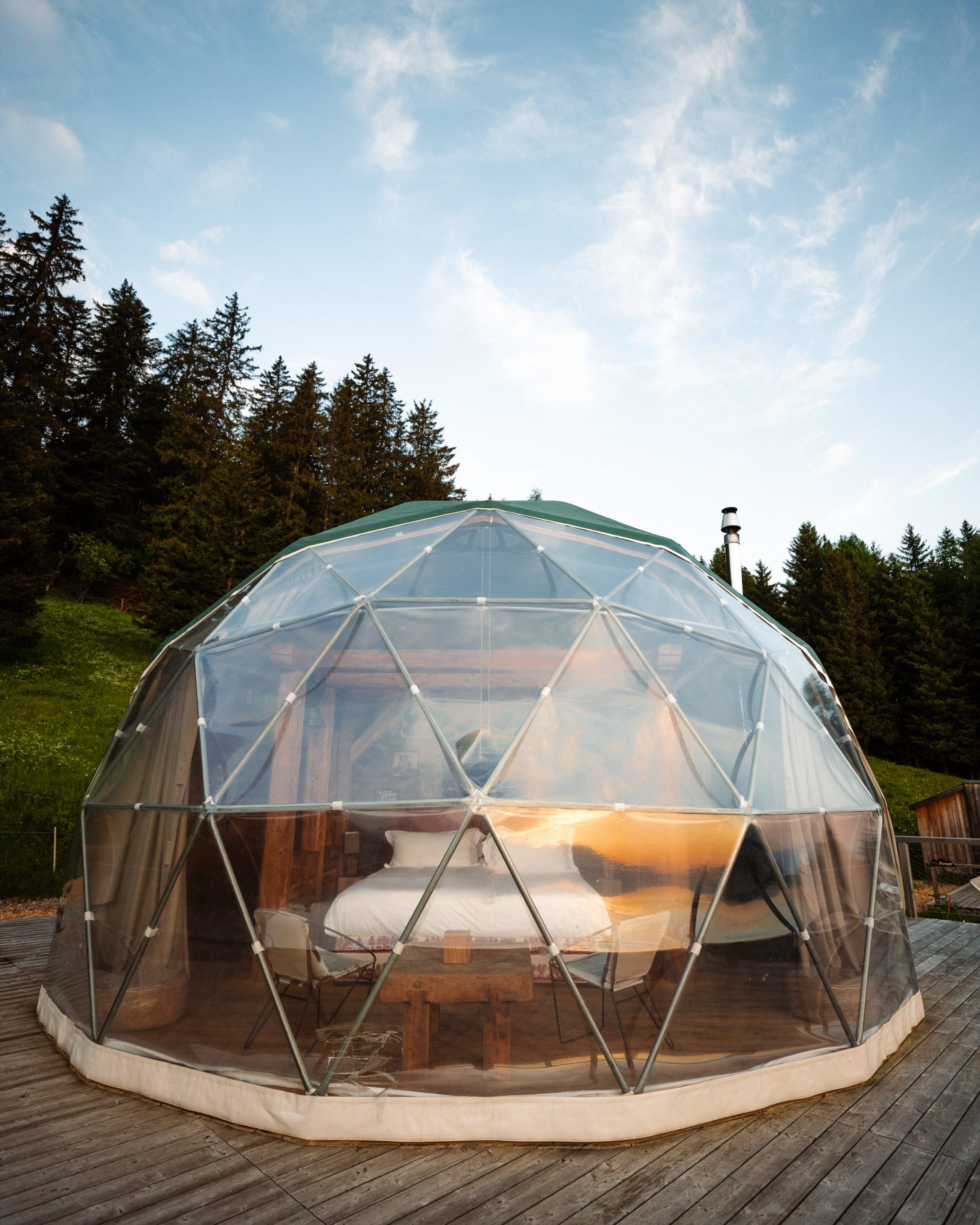
Sturdier than a bubble, warmer, better suited to the alpine climate. Large glazed bay, stove, sometimes a transparent ceiling for the stars. Growing in the Grisons, the Jura and the Prealps.

Yurt

The Jura and the Vaud Jura have made this their speciality, often on organic farms or in eco-communities. Central stove, dry toilets, communal spirit. The most affordable Swiss unique stay, open most of the year.

Wine barrel and tiny house

Winegrower barrels in Valais (Salgesch, Sierre, Chamoson), tiny houses on the Plateau and in the Seeland. Short-break format, often minutes from a station, perfect for a first night off the beaten track without wrecking the budget.

Where to stay in Switzerland

Valais

Mayens, winegrower barrels, hanging tents in the Entremont, igloos in Zermatt. The sunniest canton in Switzerland also holds the largest number of unusual addresses, from the vineyards of Salgesch to alps at 2,000 m.

Grisons

Davos, Klosters, the Engadine, the Val Müstair. Igloo village, domes, isolated chalets, SAC huts. This is also the region of the Swiss National Park, where environmental rules are the strictest in the country.

Bernese Oberland

Gstaad, Lauterbrunnen, the Jungfrau. Alpine chalets facing glaciers, igloos, mountain stays served by an exceptional rail network: you reach 2,000 m without ever touching a steering wheel.

Jura & Vaud Jura

Yurts, treehouses, wagons, organic farms, wooded pastures and very dark skies. The Jura is the entry point into Swiss unique stays — and probably the country’s most sincerely ecological region.

Vaud, Fribourg & Gruyère

The Vaud Alps, the Pays-d’Enhaut, the Fribourg Prealps: bubbles, domes, alpine chalets an hour from Lausanne or Bern. The best change-of-scene per kilometre for a weekend.

Central Switzerland

Lucerne, Uri, Schwyz, Lake Lucerne. Lakeside cabins, alps reached by boat then funicular — the country’s most elegant car-free arrival.

Ticino

The Verzasca, Maggia and Bavona valleys, restored stone rustici, palm trees below and snow above. Mediterranean atmosphere, and prices often gentler than in German-speaking Switzerland.

Typical prices in Switzerland

Observed ranges for two people, one night, in Swiss francs. Switzerland is expensive: expect CHF 180–400 for most unique stays, often with meals included in the mountains.

Wine barrel or simple cabinCHF 90 – 150
SAC mountain hut (half board, per person)CHF 80 – 130
YurtCHF 130 – 210
Tiny houseCHF 160 – 250
Alpine chalet or mayenCHF 190 – 330
TreehouseCHF 200 – 310
Dome or lodge with a viewCHF 240 – 390
Bubble or igloo (half board included)CHF 300 – 480

February–March weekends (igloos) and July–August weekends (alps) sell out four to six months ahead. A Tuesday in June or September often costs 30% less — and the mountain is empty.

When to go

Spring · April to June

Snowmelt, waterfalls in spate, crocuses on the alps. Many high chalets only open in June: check the dates. The Jura, Ticino and the Plateau, on the other hand, are perfect from April.

Summer · July and August

High season, and the only window for the highest mayens and unstaffed SAC huts. Bubbles and cabins with hot tubs are stormed: book very early.

Autumn · September to November

The best season, without hesitation. Clear air, golden larches, cattle descents, falling prices. Careful: many alps close in mid-October.

Winter · December to March

The season of igloos, wood stoves and ski touring. Always check access: some stays are only reachable on snowshoes or by sledge, pack on your back.

What we check before listing

In Switzerland comfort is a given; ecological sincerity is not. Our six criteria are concrete and verifiable on site.

1

Energy

Solar (very common at altitude), heat pump, wood stove burning timber from the valley. A “nature” chalet heated by oil or direct electricity does not pass, however fine the view.

2

Water

Dry toilets, gravity-fed spring water, reed-bed treatment of greywater. At altitude the resource is limited: a serious host says so and equips accordingly.

3

Materials

Swiss larch and spruce, local stone, sheep wool or wood-fibre insulation, restoring old mayens rather than building new. Be wary of brand-new composite lodges.

4

Food

Alpine cheeses, village bread, Valais or Vaud wines, Bio Suisse Bud products. In the mountains, well-sourced half board matters more than any symbolic gesture.

5

Mobility

This is the Swiss trump card. Train, postbus, funicular: a stay reachable by public transport — with the last kilometre on foot — halves the footprint of the trip. We systematically favour those addresses.

6

Certifications

Ibex Fairstay (formerly the Steinbock label), Swisstainable, Bio Suisse Bud, EU Ecolabel. A self-awarded label or an internal charter counts for nothing.

Frequently asked questions

Where can I sleep in a cabin in Switzerland?

For a treehouse: the Jura, the Vaud Jura and the Romandy Plateau. For a mountain hut: the 150 refuges of the Swiss Alpine Club, in the Valais, Bernese and Grisons Alps. For an alpine chalet or mayen: Valais, the Oberland and the Gruyère.

Can you really sleep in an igloo in Switzerland?

Yes. Igloo villages are rebuilt every winter in Zermatt (2,727 m), Davos-Klosters and Gstaad, from December to April. You sleep in an expedition sleeping bag, with fondue dinner, night snowshoeing and an outdoor hot tub. Expect CHF 300–480 for two, half board included.

Are there bubbles with a view of the Alps?

Yes, and they are among the most sought-after stays in the country: bubbles facing the Matterhorn, the Dents du Midi, the Fribourg Prealps. They book months ahead. Above 1,500 m, most only operate from June to September.

Can you go without a car?

Yes, better than anywhere else in Europe. The SBB network, postbuses, funiculars and boats serve almost every valley floor. Many stays are a 20- to 60-minute walk from a stop — which is part of the experience.

What budget for a romantic night?

Expect CHF 200–310 for a treehouse, CHF 190–330 for a private alpine chalet, and CHF 300–480 for a bubble or igloo with dinner included. The Jura and Ticino remain clearly cheaper than Valais and the Grisons.

Are unique stays open all year?

No. Mayens and alps generally open from June to mid-October; igloos from December to April. Yurts, tiny houses, domes and isolated cabins in the Jura and on the Plateau welcome guests year-round.

Do I need a label to be sure of the eco credentials?

Labels help: Ibex Fairstay and Swisstainable are the national references, and the Bio Suisse Bud guarantees an organic farm. But a mayen with no electricity, heated with local wood and reached on foot, often beats a certified 80-room hotel.

Explore other destinations

Switzerland is an excellent starting point. Here is what comes next.

Do you run a unique stay in Switzerland?

We are actively looking for genuinely committed mayens, cabins, yurts, domes and bubbles, from Valais to the Grisons and across the Jura. Direct listing: free, for life. No commission.

Updated : June 28, 2026